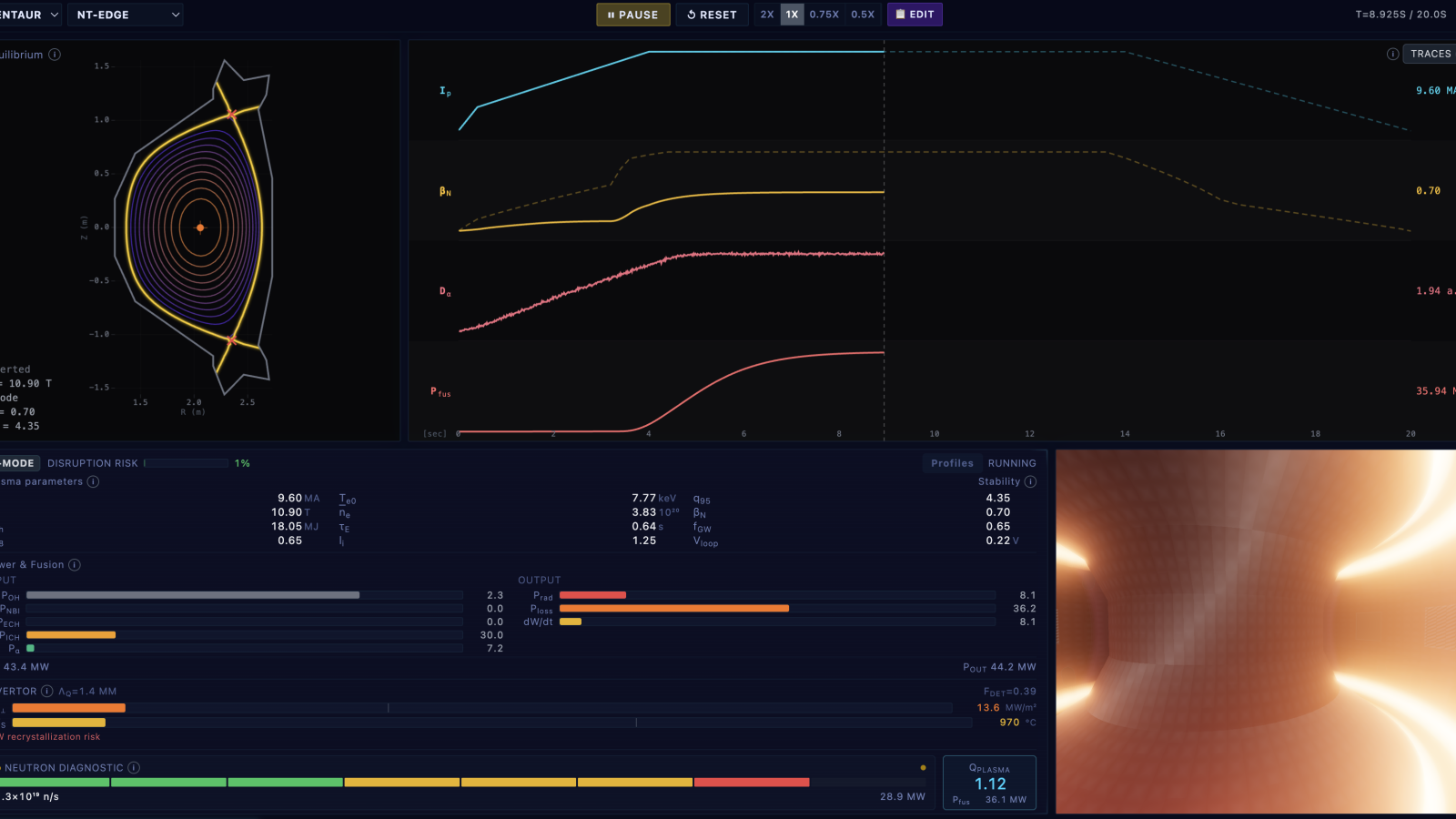
fusionsimulator.io is a free, interactive web application that brings the dynamics of a tokamak discharge to your browser. Built on a custom physics engine compiled into a self contained web app, the simulator lets researchers, students, and anyone curious about fusion energy run, watch, and edit plasma discharges in real time – no installation, no account, no cluster required.
The simulator currently models four devices spanning the modern tokamak landscape (with more slated to be added soon): DIII-D (the long-running scenario development workhorse), JET (Europe's recently decommissioned record holder), ITER (the next-step burning plasma experiment under construction in France), and CENTAUR (a conceptual high-field, negative-triangularity breakeven design designed by Columbia and Princeton students). Each is configured with its own geometry, heating systems, wall material, and operational limits. Users can run pre-programmed H-mode, L-mode, and density-limit scenarios, or open the discharge editor to draw their own waveforms for plasma current, toroidal field, density, NBI/ECH/ICH heating, shaping, and impurity seeding.
The physics engine – while relatively lightweight for a full-device simulation – is still built from rigorous experimental scaling laws and fundamental equations. It combines the IPB98(y,2) energy confinement scaling with a 0D power balance, Bosch-Hale fusion reactivity integrated over the distribution of pressure inside the plasma, an analytic Grad-Shafranov equilibrium, Martin 2008 L-H transition thresholds, a stochastic ELM model with Type I / Type II / QCE regimes, Eich-scaled divertor heat flux with a 0D thermal model for the target surface temperature, and a multi-channel disruption risk evaluator. All of this runs at 200 physics steps per second in the browser at native speed.
What you can do:
- Watch a tokamak discharge unfold in real time, with simultaneous views of the 2D equilibrium cross-section, 19 channels of time-trace diagnostics, parameter dashboards, and a 3D port-view rendering of the plasma and divertor
- Switch between devices and presets in seconds to compare ITER's burning plasma to JET's DT-record campaigns or DIII-D's flexibility
- Edit the discharge waveforms directly — change the current ramp, push the density toward the Greenwald limit, seed neon, or extend the flat-top — and rerun
- Scrub through completed discharges to inspect any moment of the equilibrium evolution and density/temperature profiles
- Trigger ELMs, watch divertor temperatures swing, and observe how Q_plasma builds up as alpha self-heating kicks in for a burning ITER plasma
Who is it for:
- Plasma physics students learning how the pieces of a tokamak discharge fit together
- Educators looking for an interactive teaching aid that runs anywhere with a browser
- Researchers and engineers in need of a self-contained outreach tool
- Anyone curious about what happens inside a fusion reactor
Limitations:
The simulator uses 0D scaling laws and analytic approximations and is designed for qualitative educational use – it is not a predictive transport code and should not be used for engineering design.
Links:
Simulator: fusionsimulator.io
- Source code: github.com/d-burg/fusion-sim
- Physics bibliography: https://www.fusionsimulator.io/bibliography (reference page covering IPB98, Bosch-Hale, Cerfon-Freidberg, Martin scaling, Eich scaling, and the 20+ other models used)
Credits:
Developed by Daniel Burgess with the Columbia Fusion Research Center. Open-source under the project's GitHub license. Built with Rust, WebAssembly, React, and Three.js.